What I learned from building my own AI agents swarm
Diary
•

Photo by Martin Katler on Unsplash
I started building with Openclaw in January 2026 and very quickly, I realized its harder than I expected. I've hit more walls than I expected. But eventually, I managed to understand what it actually takes to run a multi-agent AI system from scratch. This is just me writing it down.
My setup
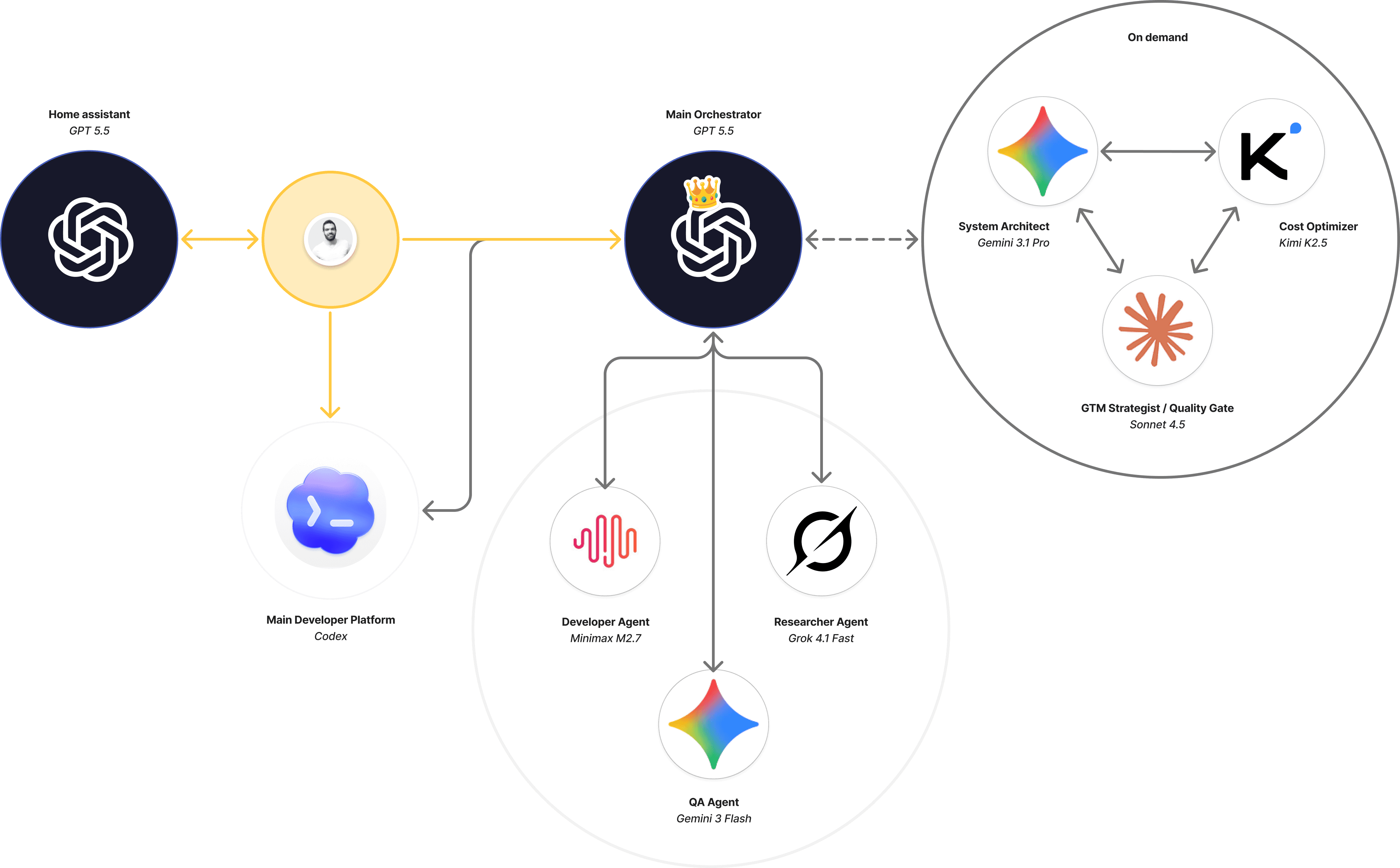
I run everything through OpenClaw on a Mac mini M4 Pro that stays on 24/7. There are three layers:
The orchestrator "Kern" is the brain. Every task routes through it first. It decides who handles what and keeps the whole thing from falling apart. Running on GPT-5.5, with Sonnet 4.6 and GLM-5 as fallbacks.
Operational agents, always on
Developer: writes and ships code.
DS Parity QA: reviews everything before it moves.
Researcher: monitors the market, surfaces what matters.
Homer: household agent. Manages calendars, reminders, and daily briefings for me and my family.
All four run a background heartbeat on Gemini 3 Flash to stay alive between tasks.
Advisory Agents, called on demand for plan reviews:
System Architect: architecture decisions and technical direction.
Cost Optimizer: keeps the stack from burning money.
GTM Strategist: go-to-market thinking and positioning.
What went wrong, and what I learned
1. Heavy memory is a recipe for failure
Every agent can only hold so much information at once. Let it overflow, and the whole system starts making bad decisions quietly. Now I limit what each agent carries, compact it regularly, and watch it closely.
2. When AI agents fail, nothing explodes. It just quietly gets worse.
One agent hits a limit. It switches to a fallback. The fallback routes differently. Everything looks fine on the surface. Without active monitoring, you have no idea if your system is actually doing what you think it's doing.
4. Securing API keys is a foundation.
I rebuilt my entire security setup mid-project because I didn't plan it properly from the start. If you're connecting multiple AI services, decide how you'll protect your credentials before you add anything!
5. The more autonomous the agent, the more you need to see what it's doing.
This is what most people miss. Autonomous doesn't mean invisible. I built a dashboard because I learned quickly how critical it is to keep a close eye on the outputs while they are running. Visibility is what makes autonomy possible.
Still very much a work in progress. But that's the point.