Design Isn’t Under Threat. It's Just Fragile.
3min read
•
Jan 28, 2026

Disclaimer: This is not a how-to or a framework, it’s a personal reflection on designing under pressure, as we enter 2026..
I used to believe that good design meant arriving somewhere. Whether it was clarity, the right structure, or alignment.
If I did the thinking well enough, asked the right questions, ran the right workshops, I’d reach a point where the system made sense. And then my job was to protect that sense from chaos.
But then my reality kept moving. Healthcare. Startups. Scaleups. Mergers. AI. Cultural shifts. Personal life. Becoming a founder, a father. Becoming.
This is a reflection on how I learned to design clarity that adapts, while still delivering direction and impact in the real world.

Becoming something else
At some point it felt like designing a perfectly balanced structure on moving ground, impressive for a moment, exhausting shortly after. (And yes, I still tried to pixel-perfect it.)
I slowly noticed that the more pressure a system was under, the more breakable “good design” became.
The cleaner the roadmap, the faster it broke.
The stronger my confidence in a direction, the harder it was to change it without feeling like I was betraying something.
And then I went on a spiral to figure out what was actually failing? Was it bad design? Incompetent design? Or something else entirely?
What if the problem wasn’t quality, but fragility.
What if the problem is in Design that assumes stability, in a world that no longer offers it.
Don't get me wrong.. I am not saying designing clarity is something we should abandon. Just make sure that this clarity can survive contact with a reality that's always on the move.
Don't rush to blame
It’s easy to blame process. Or orgs. Or regulations. Or Europe. But fragility lives in the identity that hardens, to a point where changing it feels like a threat!
“I am a designer who does this kind of work, in this kind of way, with this kind of impact.”
If that sentence felt familiar, you might want to read this twice.
Because once identity hardens, constraints feel like interference. Shifting priorities feel like failure. And ambiguity feels like loss of control.
When anti-fragility actually make sense
I found anti-fragility, the non-theory aspect of it, by shipping things that weren’t final. And watching my pixel-perfect, detail-obsessed inner designer quietly panic… YET THEY WORKED!
Anti-fragility, as Nassim Nicholas Taleb frames it in Antifragile, is about getting better because things change.
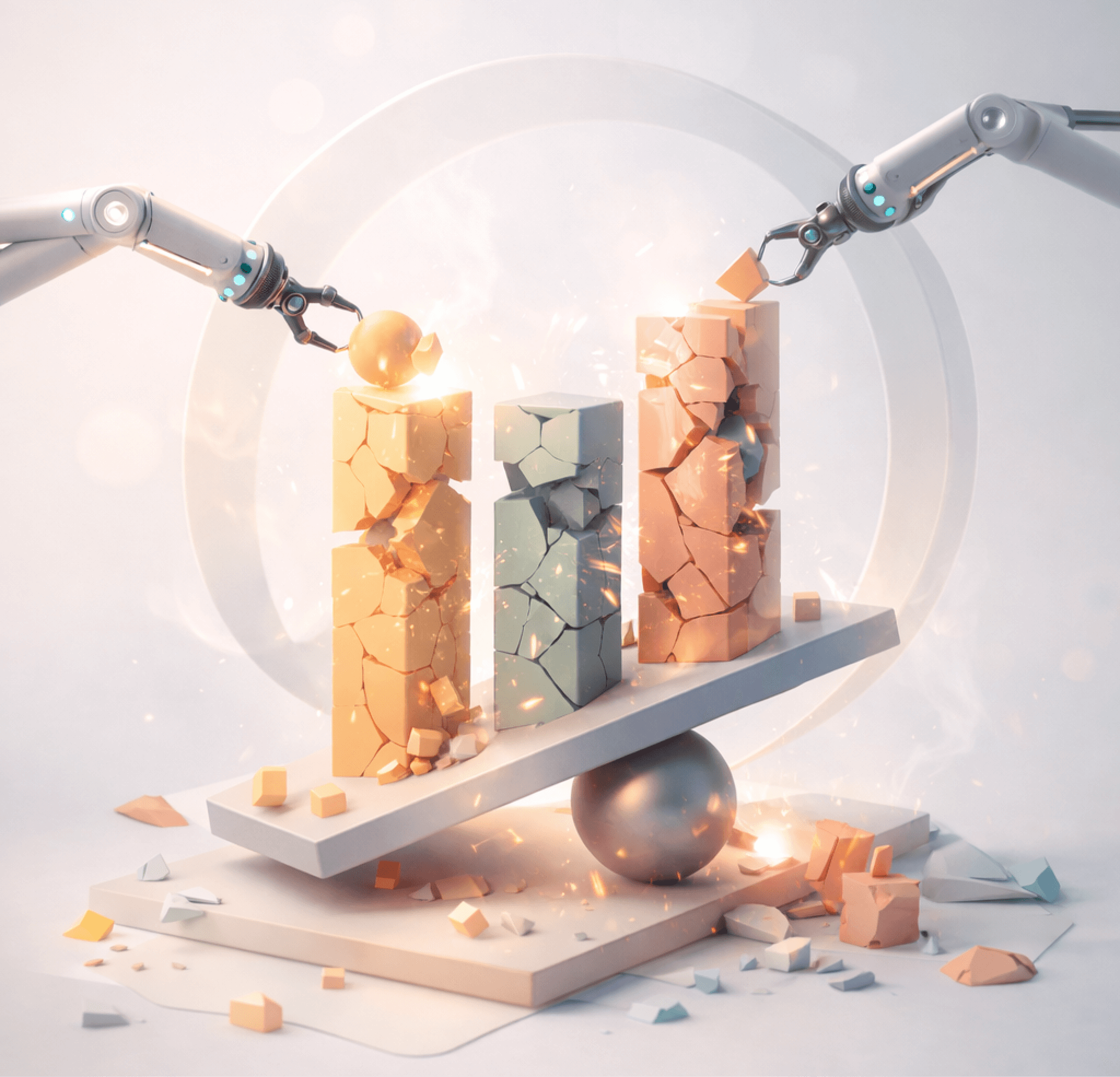
So next time you see parts of the system safely break, also see that something better could take place.
Keep walking. Not everything needs to be resolved at once.
Never freeze. Not every rational decision needs to be defended forever.
Let pressure teach you. Some clarity only shows up after you move
At scale, this mindset is often the difference between systems that need constant rescue and systems that keep working while the ground shifts.
Constraints don't kill creativity. Our reaction does

David Kelley and his brother talk about in Creative Confidence:
“Constraints are not the enemy of creativity. They are the fuel.”.
I first read this (highly recommended) book while teaching at USEK in Lebanon, trying to unlock my students’ creative potential. Something clicked back then, not realizing how much it would shape my own work later.
Now looking back, the most meaningful work I’ve done came from
Regulation I couldn’t ignore
Users I couldn’t “simplify”
Systems I couldn’t replace
Trade-offs I had to own
Learning which constraints deserve respect, and not putting the effort to remove them is Anti-fragile design.
What I learned from my reflection on this topic
It's easy to rant about how "A company is broken" or that "Leadership is a failure" or that "This system does not work". But no truth framed that way brings meaningful change.. Clarity of your impact, role and identity is something you keep renegotiating as the world changes.
So don't try to eliminate uncertainty! But build things that get better because uncertainty exists. Because if you’re designing future-proof structures by assuming the world will stop moving, you’re already behind.
Stop trying to “arrive once and for all” and start designing as if change itself is the material.
Observe how the world moves, and move with it.
In the mood for more reading?